


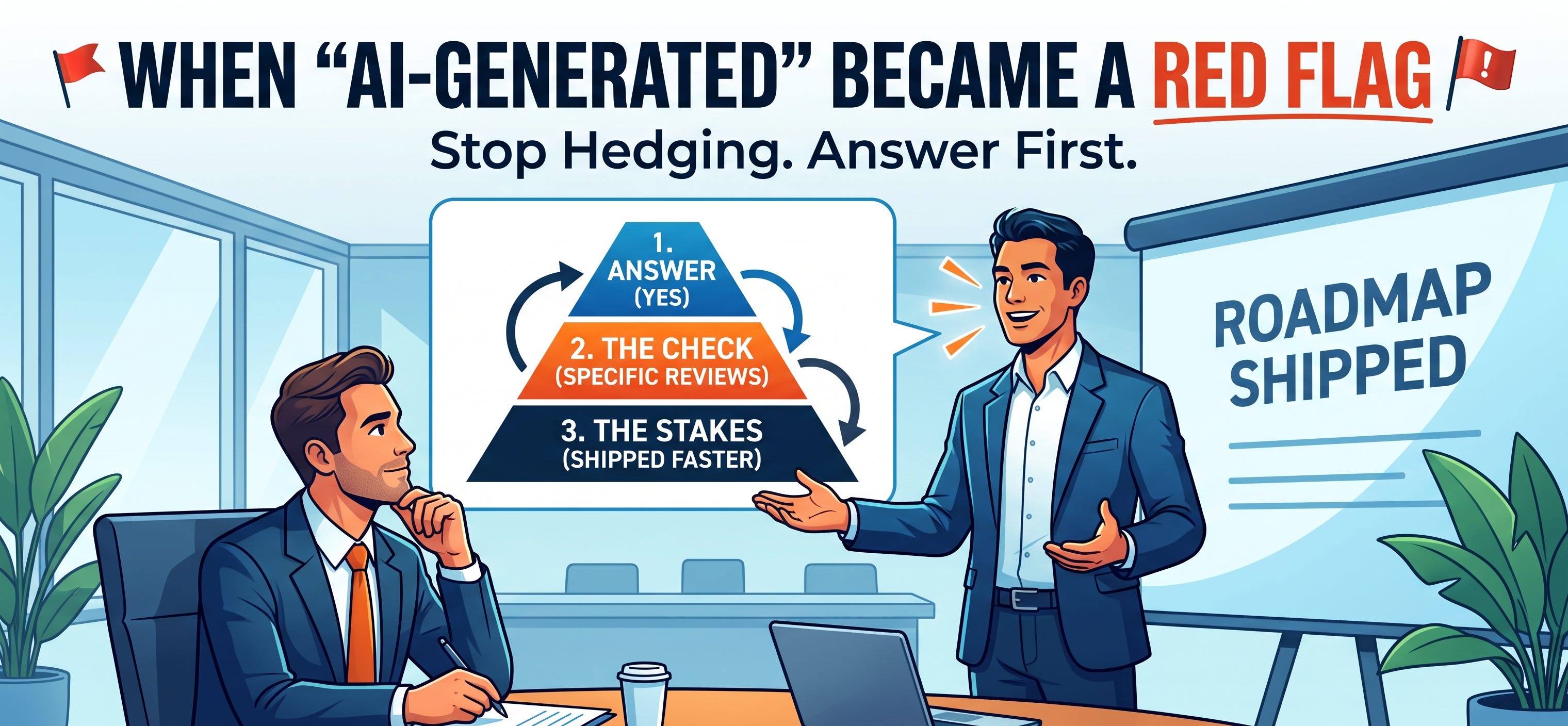
You’re four slides into the investor update. Revenue’s up. The roadmap you promised for Q3 shipped in six weeks instead of twelve, and you’re mid-sentence explaining how, when the partner across the table leans back and asks, flat: “Wait, is this AI-generated?”
The room doesn’t move, but you feel it get colder.
“I mean, yes, partially, we used it for the front end, but obviously we reviewed everything, it’s not like we just...” You hear yourself trailing off before you’ve actually said anything. You’re three sentences in and you still haven’t answered the question.
The partner nods, makes a note you can’t read, and asks something about the numbers instead. The meeting keeps going. It’s fine, technically. Nobody says anything else about it. But you know, the way you know when a room has quietly reclassified you, that something shifted. Two weeks later, the term sheet timeline slips “to do a bit more diligence.” Nobody says the word AI again. You know anyway.
Here’s the part that stings. The work was good. You’d actually checked it. You knew exactly which parts a system had verified automatically and which parts a person on your team had read line by line before it shipped. You just didn’t say any of that, because in the moment, the only thing you could hear was the accusation you assumed was sitting behind the question.
What Actually Cooled the Room
They weren’t asking whether you used AI. Everyone at that table has used it that same week, probably that same afternoon. They were asking a much narrower question, wearing a bigger one’s clothes: do you actually know this is right, or are you hoping it is? And the answer they got, three sentences of hedging before you landed anywhere, sounded exactly like the second one. Even though the truth was the first.
That’s not a knowledge problem. You had the answer sitting right there. It’s a structure problem, and it has nothing to do with AI at all.
The Fix: The Answer-First Script
There’s a name for the structure you were missing. It’s called the Pyramid Principle, and it’s the shape McKinsey trains its consultants to lead with whenever someone with ninety seconds and zero patience needs to trust a claim fast: state the conclusion first, then give the minimum proof the listener actually needs, in the order they need it. Not the story of how you got there. The answer, then just enough behind it to make the answer safe to believe.
For a moment like the one above, that shape breaks into three sentences, in this order, every time:
The Answer. No qualifiers, no scene-setting. “Yes, we used AI for part of this.” State it like a fact, because it is one.
The Check. Name, specifically, how you know it’s right. Not “we reviewed it,” which means nothing to a stranger. Name the actual check: what a system verified automatically, what a person actually read and signed off on.
The Stakes. Connect it to what they actually came to hear. This is why it shipped in six weeks instead of twelve, and why that gap should make them lean in, not pull back.
That’s the whole script. Answer, proof, payoff, in that order, before you let yourself explain anything else. Everything after those three sentences is optional. Before them, you have nothing but a room deciding what to think of you while you’re still finding your point.
How to Use It
Before your next client or investor conversation, write your three sentences out in advance. Say them out loud, timed, under fifteen seconds total.
Lead with the answer even if nobody asks yet. If the topic is likely to come up, don’t wait for the ambush version of the question.
If they ask a follow-up, answer it the same way: point first, one sentence, then stop talking.
The Answer: “Yes, we used AI to build [the specific thing].”
The Check: “[Specific system check] confirmed it automatically, and [specific person] reviewed [the specific judgment call] before it shipped.”
The Stakes: “That’s the difference between [old timeline] and [new timeline], without cutting the corner you’re worried about.”
Back in the Room
Same partner. Same question, same flat tone: “Wait, is this AI-generated?”
This time you don’t flinch. “Yes, we used it for the front end. The data layer changes were checked automatically against our existing tests, and our lead engineer read every line that touched customer data before it shipped. That’s how we hit six weeks instead of twelve.”
Silence again, but a different kind. The partner nods, actually writes something down this time, and asks how you’re planning to scale that process as the team grows. That’s a different meeting. Same facts, same product. The only thing that changed was which sentence came first.
The Bottom Line
“AI-generated” was never the actual red flag. An answer that takes three tries to find its own point is. Say the true thing first, prove it in one sentence, and let the room decide you’re someone who knows exactly what you shipped. Because you do.