


Third post of Season 1. Last time, I handed over the one-page habit I’ve been using to keep decisions from disappearing into a prompt: a file called Build Notes, and a question to ask before touching the code. This is the story of the one time I didn’t bother.
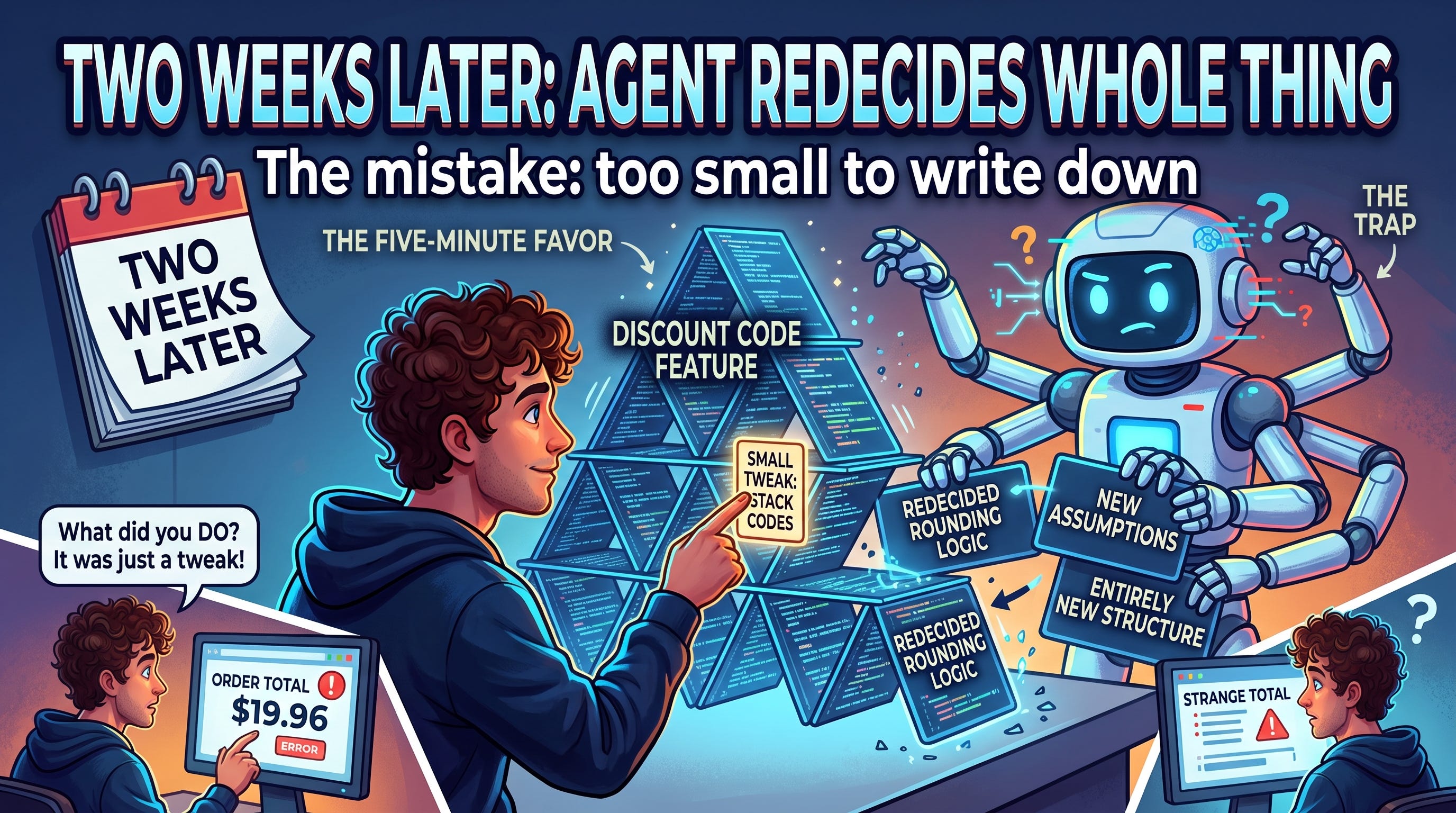
The Five Minute Favor
A client messaged me on a Tuesday asking for a discount code field on checkout. Nothing dramatic, just a box where someone types a code and the price adjusts. The message was three sentences long and ended with “shouldn’t be a big deal, right?”
I opened the project between two other things and typed the ask straight into the agent, more or less word for word. It came back with two quick questions: percentage off or flat amount, and should a code stack with items already on sale. I answered both in the same breath I’d answer a coworker asking where the stapler was. Percentage, sure. And no, don’t stack, keep it simple.
Twenty minutes later it worked. I tested it on a sale item to be sure the “no stacking” part actually held, watched the price behave exactly the way I’d said it should, ran one more test on a full-price item just to be thorough, and closed the laptop feeling like I’d knocked out a quick win before lunch. It didn’t feel like I’d made a decision. It felt like I’d done someone a favor, the kind you forget about by the time you’ve made your sandwich.
The Second Ask
Two weeks passed. The same client messaged again, this time wanting the discount to also apply during their upcoming site-wide sale, so codes and sale prices would need to work together after all. Reasonable ask, business needs change, and honestly the kind of request that makes a client feel good about hiring someone who can just handle it.
I went back into the project and asked the agent to update the discount logic so codes could stack with sale pricing. It made the change without hesitation, confident as ever, and along the way it also quietly decided how rounding should work when both discounts applied at once, since nobody had ever told it otherwise. It picked something sensible. It also picked something different from what I would have picked, and I only found that out three days later when a test order came out four cents lower than expected.
Four cents doesn’t sound like much until you’re staring at an order total that shouldn’t be possible and trying to figure out which of two discounts is being applied in the wrong order. I asked the agent to walk me through its math, and it explained the rounding approach clearly, calmly, like it had always worked this way. In a sense it had, just not the way I’d have chosen, and not in a way anyone had actually signed off on. I went looking for the original “don’t stack” decision to understand what it had been protecting against in the first place. There was no note. No comment. Nothing except a feature that had worked one way two weeks ago and now worked a different way, one small assumption at a time, with nobody having decided any of it on purpose.
The Part I Don’t Love Admitting
Here’s the honest part. I had just spent an entire piece telling you to write these decisions down before you build. I believe that advice, I’d argue for it in front of anyone. And I still didn’t follow it here, because a discount code field felt too small to count as a real decision. It felt like answering a quick question, not making a call that would matter in two weeks.
That’s exactly the trap, and I don’t think it’s a personal failing so much as how these small moments are built to slip past you. The big, obviously-important decisions are the ones people remember to write down anyway, because they feel like decisions while you’re making them, there’s a little internal alarm that goes off. It’s the small ones, the “sure, whichever’s easier” ones, that vanish, precisely because they don’t trip that alarm. Nobody sits there thinking “this is a load-bearing choice,” they’re thinking “I’ll answer this so we can move on.”
I’ve been using Build Notes for about a month now, and this was the first time skipping it actually cost me something concrete instead of theoretical. Not because the habit failed. Because I made a judgment call in the moment that this particular decision didn’t need it, and I was wrong about that, in a way I only found out three days and one confusing order total later.
It did need it. Most of the small ones do.
Have you ever skipped writing something down because it felt too small to count as a decision? What did it turn into two weeks later?